'Members' Evening: Presentation of Research by WHS members' - 25 September 2026
As a continuing part of his survey of the development of modern London in the 1860s, Nigel Black examined the effects of Metropolitan Poor Act of 1867, which determined the creation of metropolitan asylum districts across the city. Infirmaries and fever hospitals were built to care for the elderly, infirm and those with contagious diseases, and remove them from workhouses. St John’s Hill infirmary was completed in 1870 and the South-West Fever Hospital at Stockwell (now demolished) was also opened. Tooting Bec Asylum has now become St George’s Hospital.
Neil Robson revealed the history of the almost-forgotten airgraph service during the Second World War. Active between 1941 and 1945, this short-lived but vital means of communication was a social game-changer and a technological wonder. Senders wrote their message on a printed form and paid 3d at the Post Office, from where it was sent on to be photographically reduced to one of 1,500 on a lightweight roll of film, despatched by air to British forces overseas and then developed onto rolls of paper, guillotined and, finally, forwarded to the recipient (any film that was shot down could easily be replicated). All too soon British Forces air letters superseded the airgraph, but today these small, postcard-sized documents are eagerly sought after by collectors.
In ‘When the Tube came to Tooting’ Philip Bradley marked the centenary of the extension of the Northern Line southwards from Clapham South, via Tooting Bec (originally Trinity Road), to Morden. Mostly dug by hand with a stretch of cut and cover, the work took three years to complete. The new stations were striking examples of the work of Charles Holden. Built of Portland stone, fitted with extensive glazing and chandeliers, these buildings lit up their surroundings – beacons of progress. They are now Grade 2 listed and intact, having fulfilled their promise to bring ‘freedom to the south-western suburbs’ of London.
Recent research in Westminster Hall was reported by Dorian Gerhold. Despite restrictions placed on excavations beneath the great window, steps and the remains of a marble table were found, probably part of the original building commissioned by William Rufus in the 1090s. Dendrochronological work has confirmed that the wood in the later hammerbeam roof can be dated as felled in 1393, the period of its construction vas commissioned by Richard II. There is still uncertainty as to how the original roof would have looked as the extreme width of the hall would have been difficult to span with the limited technical knowledge of the 1090s. Were there columns? If so how many and how disposed? Were scarf joints used, as in shipbuilding? It seems certain that the structure had a shingle roof, indicating anxiety about the weight-bearing abilities of whatever structure was used, and by the time of Richard’s new works the walls had indeed been pushed out of alignment. Whatever conclusion is reached, it is clear that the roof must have been pushing the boundaries of contemporary knowledge and techniques.
Celia Jones
'Roman Putney Revisited: Sixty years of archaeological excavations, research and discoveries by Wandsworth Historical Society, 1962–2026 '– 31 July 2026
Speaker: Dr Pamela Greenwood, Wandsworth Historical Society
Pamela began by mentioning the two current projects involving the WHS: The Roman Rivers project in co-operation with Reading University and the Hilary Sims Bequest project looking at structures and finds on the Wandsworth foreshore.
Pamela then gave us a history of the excavations from 1962 when, following the uncovering of Roman burial urns in Bemish Road, the archaeological group was first set up by Nick Fuentes. New excavation methods lead to interesting discoveries in the 1970s and subsequently in and around Felsham Road, Gwendolyn Road and the Platt.
Finds were mostly pottery, but with a substantial number of coins from various places in the Empire, including Germany and Italy. Later developments in the area revealed the existence of buildings in the Felsham Road area and a range of building materials and fittings, all of which suggest a long-standing settlement of considerable status – possibly the in connection with the river crossing. The finds were of international provenance, including Samian ware and amphorae from Andalucía.
A hoard of 203 coins, dating from 388–402 was unearthed on the foreshore off Wandsworth Park. The fish-trap on the foreshore probably dates from between 410 and 620, and it is hoped that funding might be found to enable carbon dating of the remains. In the 1990s, work at Point Pleasant revealed that what had been water meadows in that area, became a more marshy area following the gradual rise in the level of the Thames.
In conclusion, Pamela announced that the book on re-evaluating Roman Putney and its foreshore will be published in 2027.
Celia Jones
'A History of Wandsworth Prison' - 26 June 2026
Speaker: Stewart McLaughlin , Curator of the Wandsworth Prison Museum
In his talk Stewart McLaughlin , Curator of the Wandsworth Prison Museum outlined the history of the prison from its construction in 1851 to the present. The prison, built to accommodate prisoners from the unhygienic Surrey houses of correction, had four wings, and a small section for women from 1852. We learned about the early prisoners’ daily lives, including sleeping in hammocks in cells 13 feet by 7, attendance (in solitary cubicles) at the chapel and hard labour for some (which, at Wandsworth involved hand-cranking machines with a resistence screw). Interestingly, prisoners often benefited from better food and healthcare than they would have had in the outside world.
Prisons were nationalised in 1878 in an effort to raise standards and further reforms followed including those arising from the Mountbatten report in the 1960s, a response to high levels of prisoners escaping.
Stewart told us about the prison’s celebrity prisoners (including James Earle Ray, Lord Haw Haw and Oscar Wilde) as well as some famous visitors, among them Charlie Chaplin and Elton John. His many anecdotes gave the audience a real taste of the breadth and depth of his knowledge.
The museum hosts more than 500 objects. Among those shown during the lecture were group photos of staff, the Prison Officers’ (unofficial) magazine and on a more macabre note, a life mask of Pierpoint the hangman and the gallows trapdoor.
The museum is open by appointment.
Kate Nichol
'The Changing Face of Wandsworth: from industry to homes' - 29 May 2026
Speaker: Mick Taylor, Wandle Industrial Museum
In his talk Mick Taylor of the Wandle Industrial Museum gave us the broad sweep of the development of the River Wandle, which with its 126 ft drop to the Thames made it ideal for industrial development. From its earliest recorded history until the 20th century the milling of corn and flour were the backbone of industry on the river, however over the years a wide variety of noxious industries came and went, including leather tanning, snuff, copper and iron processing, dying and calico printing, the making of parchment, malting and flock mills. All contributed to the degradation of what was a fine chalk stream.
By 1801 royal assent had been given for an innovative new iron railway with horse-drawn wagons running from Wandsworth to Croydon via Mitcham – the first in the UK. However, by mid-century this was superseded by the rise of the steam locomotive, and what remains of the track is now beneath the Tramlink running from Wimbledon. Mick showed photographs of several of the many vanished mills along the river, including the Upper, Middle and Lower mills around and now beneath the present-day Southside shopping centre.
Celia Jones
'Secret history: Richardson Evans, conservation pioneer' - 24 April 2026
Speaker: Michael Norman-Smith
Michael, Chair of the Chair of the Wimbledon Society Local History Group, spoke to us about the little-recognised Richardson Evans, whose name is now mainly remembered in the official title of the Richardson Evans Memorial Playing Fields which run along the A3. Evans was a man of many parts and many careers: he began as an official of the Indian Civil Service on India’s North-West Frontier, and was invalided out to England, where he became a journalist for the Pall Mall Gazette and the Evening Standard, and was also an author.
Later he was involved with the creation of the Wimbledon Choral Society, and during the First World War worked with Belgian refugees. However, over and above all these activities Evans spent the greater part of his life campaigning to arrest the despoilation of England’s, but particularly Wimbledon’s environment. Michael told us how in 1903 Evans, together with a group of like-minded men, founded what is now the Wimbledon Society as well as the Wimbledon Museum, which over the years has a commendable history of campaigning to preserve the amenities of Wimbledon.
Celia Jones
'Preserving Wandsworth's Legacy: Developments in the Wandsworth Heritage Collection' - 27 March 2026
Speaker: Antía Dona, Culture and Heritage Programmer, Wandsworth Council
As Wandsworth’s Culture and Heritage Programmer, Antía Dona Vázquez explained that her remit encompassed custodianship, preservation, accessibility and community engagement. In a wide-ranging talk, covering past, present and future plans, Antía explained how she and her team of volunteers are slowly discovering and digitising the collection of over 14,000 items and she has a programme to conserve a number of the items that are most in need of care as well as a carefully planned deaccession list. However, because there is now no physical museum the last two of her tasks are not at all easy to achieve. Her budget is very limited and her contract runs only until February 2027, but Antía is working with local organisations, including the Archive Service and the University of Roehampton to bring as much of the collection into the open as possible. She has created Dementia Memory Boxes containing 5-10 objects that can be lent out, and launched the Story Catchers and Memory Kitchen schemes, which taps into the memories of local residents and is intended to use and augmenting the oral history collection. She also has plans for ‘mini museums’, which will display a limited number of related items in local libraries, including a forthcoming display of watercolours at Putney Library. As well as all this Antía has developed a policy document covering the years from 2024 to 2029.
Celia Jones
Reconstructing the map of London on the eve of the Great Fire of 1666 - 27 February 2026 (Online via Zoom)
Speaker: Vanessa Harding, Professor of London History at Birkbeck.
This is a very large-scale project and is dependent on funding from a variety of organisations and will use the latest techniques of digital mapping overlaid on a digitised and stitched Ordnance Survey map of 1897. The researchers are drawing on a variety of sources, including the few maps from the immediate period, artistic images such as those by Wenceslaus Hollar, hearth-tax returns, bills of mortality and contemporary diaries as well as the surveys produced in the immediate aftermath of the Great Fire.
The project researchers have divided their task into parishes and are gradually mapping their findings, which will show, parish by parish, a city combining two centres, the old City and Westminster. There are many complications to be considered, including the fact that over the years the boundaries of the City have changed in line with later developments and that during the nineteenth century many streets were either swept away or subsumed into wider thoroughfares. In line with previous publications in this series, there will also be a street directory and bibliography. The size of this project has dictated the decision to publish in atlas format jointly with the London Topographical Society and the hope is that it will appear by mid-2027. Further details appear on The Historic Towns Trust website.
Jenny Massey and Celia Jones
16th Nick Fuentes Memorial Lecture 'The Roman River Finds Project' - 30 January 2026 (Online via Zoom)
Speaker: Hella Eckardt, Reading University
The project is an Anglo-German initiative involving the universities of Koln, Trier, Leicester and Reading to investigate new approaches to Roman River finds. It began in 2024 in Germany, and is expected to continue until around the middle of 2027. The talk was divided into four sections.
Issues
The reasons things are deposited in rivers are numerous including, deliberately, accidentally, from shipwrecks, rubbish dumping and erosion of land settlements. All of these factors could contribute to an assemblage. Only the most spectacular objects were collected and recorded in the past and these have not been looked at in a wider context. The confluences of rivers are significant, also bridges, and local river gods. Deposition can be over a long period and dredging can cause movement and loss.
Ways Forward
Hella described work done on finds from the River Tees at Piercebridge to the west of Darlington. Here the Roman Dere Street crossed the river via a bridge and there was a Roman civilian settlement and later a fort to the north. There are far more Roman finds than from other periods, all have been described and catalogued via the portable antiquities scheme. It has been noted that some come from other parts of the Empire which is not unreasonable as this was the road to Hadrians Wall. There are over 2000 coins from fort excavation and over a 1000 from river, with those from the river showing higher value denominations than from the fort so much more likely to be deliberate deposition rather than accidental losses.
The UK experience – this is still work in progress
Finds data has been collected data into a database. It is often the case that what were considered as river finds are not really so, for example where a river has moved its course and eroded a dry land site or the distance of the finds from a river was not well recorded. These make sites difficult to categorise.
Putney is being used as a case study using data supplied by Pamela Greenwood, The project has tried to map all the locations of finds, this shows there are far more downstream of the Putney Roman bridge. Another area of the Thames for study is around London Bridge but the Roman foreshore was much further back than the current one. Demolition of old London Bridge led to lots of material from the river in the 1830s but while some locations of finds are accurately recorded, others were vague. These finds are now being fully catalogued. Billingford near Worthing (Norfolk) has also been studied.
The German city of Trier on the River Moselle
Trier was an important Roman city with the bridge piers surviving from Roman period. Due to low water conditions in the 1970s and 1990s many local people went into the river and found lots of items. Over 30,000 coins and 1000 lead seals are recorded but it is estimated that over 500,000 coins may have actually been retrieved with many remaining in private hands. Interestingly here personal adornment objects are not a majority of those found. Work is ongoing to analyse this huge collection of finds.
Colin Jenkins
'Shakespearian playhouses' or 'The Past, Present and Future of Theatre archaeology in London'- 28 November 2025 (Online via Zoom)
Speaker: Heather Knight, MOLA
The speaker has been in charge of the excavations of 3 theatres from the Elizabethan period so is well qualified to talk on this subject. It is an area where archaeology has greatly expanded our knowledge in particular over the last 20 years because there are very few contemporary images. The Rose was the first site to be investigated in 1989, followed by the Hope in 1999-2000 and since 2008 the remains of The Theatre, Curtain, Red Lion and Boars Head have been excavated.
Nine playhouses are now known with a cluster in North London and the better known ones on Bankside. The Rose was found to be 14 sided originally, remodelled in the 1590s to be horseshoe shaped. Others such as The Curtain were round and some were rectangular so it is now assumed that the various shapes all coexisted and are likely to have suited different styles of drama.
The speaker reflected on the importance of the preservation of these sites and linking them to the modern world, for example with the “Before Shakespeare” project setup in 2016 and A Museum of Shakespeare which is being created at the site of The Curtain.
Colin Jenkins
'Barn Elms Tideway Site Report: Going to town on an Iron Age oppidum'- 31 October 2025
Speaker: Mike Curnow
Mike Curnow, Project Officer at MOLA, brought us up to date with the findings at this site. He began by reminding us of the origins of the research and excavations, beginning in 2025/26 (mentioning of course the 1974 dig by WHS, which unearthed the first Iron Age PAS and historic finds). Recent excavations cover the years 2019-21, and it is the finds during that dig that are the subject of ongoing analysis and of Mike’s talk and for his conclusion that the site can justifiably be termed an ‘oppidum’. Extensive work on post holes has revealed three separate types of building: a rectangle (unusually), a semi-circle and a typical set of holes such as is found in classic roundhouses.
Radiocarbon dating of the contents of the ditch on the site, including a human bone, suggest that bodies were possibly left to de-flesh. Of the pottery on the site, initial analysis gives the place of origin of many objects as Marseilles. Finally, tests on the stone pieces were inconclusive, although one blade appears to date from the lower Palaeolithic period. Further analysis on the finds from the site is being undertaken – on the registered finds, on more of the pottery as well as environmental analysis of bone, plant and food remains.
Celia Jones
Annual Members Evening - 26 September 2025
Our annual members evening has now moved to September rather than November.
This year the following were featured:
We began with Norma Cox, whose researches into Merton businesses reached New Malden, beginning with Shannon Corner, named after Shannon Ltd, who manufactured office equipment there from 1883. Decca Radar had several factories in the same area of New Malden until the end of the last century. In 1917 the printers Bradbury Wilkinson moved to New Malden, where they printed bank notes for many countries. Meanwhile, in nearby Merton, Ferguson’s rubber factory produced, among other things, a large model of a ram for Young’s Brewery.
Neil Robson extolled the virtues of Ernest Shackleton, ‘the gift that goes on giving’. Three years ago the site of the sinking of HMS Endurance was finally located and photographed. In 2023 Shackleton’s Polar Medal with three clasps came up for auction and is now in the Polar Museum in Canterbury, New Zealand. Finally, in 2024 the original wooden cross from the Shackleton memorial cairn in South Georgia was moved to its final resting place in Discovery Point museum in Dundee.
In ‘A bend in the road: Garrett Lane’ Imogen Grundon made the case for this intriguing local quirk being the site of a temporary Roman marching camp, thrown up during the invasion of Julius Caesar in 54BC. This could mean that the army landed near Hythe, followed waterways northwards through the Caterham Gap, and crossed the Thames near the River Wandle, instead of taking the more easterly route hitherto suggested by historians and archaeologists.
Nigel Black continued his researches into organisations involved in the development of London as a great metropolis in the nineteenth century. The city’s fire brigade was founded in 1866, when the Metropolitan Board of Works centralised all the various brigades set up by insurance companies. Acts regulating the supply of water and the creation of fireplugs were passed, new brass helmets were designed and a rapid expansion plan created new fire stations.
Celia Jones
'Wandsworth Historical Society 60 years and more on the Wandsworth Foreshore' - 25 July 2025
Speaker: Pamela Greenwood
Pamela began by pointing out that the society has been studying the foreshore for over 60 years, but it is not clear how much over the sixty. The first independent WHS activity was a visit reported in the Wandsworth Borough News on 14th August 1964, Roman pot was found and it is believed that boats were used as it was in conjunction with the local Sea Scouts. The Thames Basin Archaeological Observers Group predates 1964 and had already been observing the foreshore for a number of years.
Virtually all subsequent work has covered the area between the mouths of the Wandle and Beverley rivers. The Putney Fish Trap was discovered in 1971. This has two radio carbon dates in the range AD 410-620 but like many other features has been washed away and Pam went on to discuss the changing foreshore over the last 60 years as it is affected by erosion and various uses of the river. For example features such as a barge bed seen in 2024 had gone by 2025.
There are numerous finds from the foreshore dating from the end of the Ice Age onwards. These were illustrated and Pamela paid tribute to three people who did so much of the work but are no longer with us, Nicholas Fuentes, Hilary Sims and Bob Wells. She concluded with a draft plan for a project to consolidate all the information about the work that has been done on the foreshore.
Colin Jenkins
'Mapping Rich and Poor: The Charles Booth Archive' - 27 June 2025
Speaker: Indy Bhullar, Curator for Economics and Social Policy at LSE Library.
The Library at the LSE holds most of the researchers’ notes for Charles Booth’s great work on poverty in London and are a valuable resource for the understanding of Booth’s Inquiry, begun in 1886. With the aid of assistants (including Beatrice Potter, later Webb, and George Duckworth), who consulted local School Board Visitors’ reports and accompanied policemen on their beats, Booth first mapped the levels of society and income in the city, depicting them in seven different colours. The Poverty Maps were published in 1889. Two years later Booth’s team began to examine the links between poverty and industry, interviewing employers and employees, the self-employed, the unemployed and trade unions in as many trades as possible, and enquiring into conditions and wages. The results were published between 1892 and 1897. For the final round of the Inquiry, the religious influences survey, the researchers interviewed members of philanthropic and religious organisations, the people most concerned with the alleviation of poverty and want. The final, revised and enlarged third edition (1902-3), ran to seventeen volumes and covered all three sections. The 450 notebooks at the LSE can be accessed via booth.lse.ac.uk. They reveal the individual and specific data underpinning the published works and are a unique record of London life at the end of the nineteenth century.
Celia Jones
'Researching the lost houses and gardens of Wandsworth Common' - 25 April 2025
Three speakers from the Heritage Group of the Friends of Wandsworth Common
The project to research the buildings around the common was undertaken by the Friends of Wandsworth Common Heritage Group, chief among them Philip Boys, Stephen Midlane and Sarah Vey, each of whom contributed to this talk. The initial impetus for the research came from earlier work done on the notable photographer Geoffrey Bevington, who lived in Ivy House on Trinity Road, near the crossing with East Hill. In 2023 the Group put out a call for volunteers, twenty-two of whom signed up. Workshops were arranged and, using the 1868 Ordnance Survey map, thirty-two houses were identified for research. The areas looked at were, roughly, Nightingale Lane, Burntwood Lane, Westside and Northside, and Bolingbroke Grove. Sadly, all of the houses in the survey have been destroyed, and in some cases very little information can be found, nevertheless, much was achieved, and several talks have been given to the Friends of Wandsworth Common. The Group are still researching and are calling for more volunteers to continue the research.
Celia Jones
'Syon Abbey revisited: shedding light on late medieval England's wealthiest nunnery' - 28 March 2025
Speaker: Robert Cowie
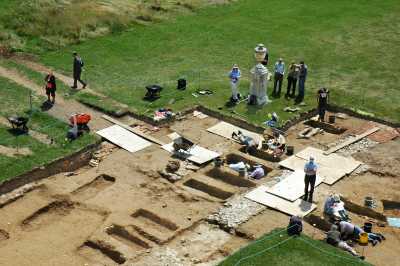
Robert began by reminding the audience that he began digging with WHS before becoming a professional archaeologist with Museum of London Archaeology. Tonight’s talk was a summary of digging in the grounds of Syon House, to locate the remains of Syon Abbey. There was a Time Team dig in 2003, but of very limited duration. Then between 2004 and 2011 Birkbeck College ran training digs each summer for students and much more could be uncovered. Here are a couple of photos of those.
 Time Team. Time Team.Photo © Robert Cowie. |
 Birkbeck. Birkbeck.Photo © Robert Cowie. |
The area had both religious and royal connections. Henry V founded Shene (Richmond) Palace, Shene Charterhouse, a Carthusian priory and Syon Abbey, a Bridgettine house. The original location was opposite Shene Palace but in 1431 the Bridgettines moved to Isleworth, in what is now Syon Park. Bridgettenes are a double order founded by a Swedish noblewoman with typically 60 sisters and 25 brothers. Their original abbey is at Vadstena in Sweden and the building arrangements at Syon closely followed the layout there. Whilst Syon Abbey was founded by Henry V, it was built by Henry VI and became one of 16th-century England’s richest religious houses.
During the various digs parts of the large church were found as well as the cloisters and residences of the sisters and brothers. The rule was that the nuns were on the north side and the brothers on the south side, each had their own enclosed convent and cloister. In the church there were separate areas with burials also divided in the same way, a number of brick lined graves have been found and some named individuals identified.
Syon Abbey was closed in 1539. In the final years of Mary I’s reign, Syon Abbey was briefly restored but later the land passed to the Duke of Northumberland and the current Syon House is his London residence.
For more information see the article in Current Archaeology magazine, issue 382, December 2021, (subcription needed).
The Bridgettenes at Vadstena have a website in Swedish.
Colin Jenkins
'A Harley Street for the Poor? The Lives and Times of the Bolingbroke Hospital' - 28 February 2025 (Online via Zoom)
Speaker: Sue Demont of The Battersea Society.
Sue concentrated her talk on four main points: the origins of the hospital; the buildings; its medical strengths and directions; and benefactions. Bolingbroke was founded in 1876 by Canon Erskine Clarke as a Providential and Self-Supporting Hospital and opened in 1880. It was a paying hospital for artisans and the ‘lower middle-classes’ – clerks, commercial agents, upper servants – people who had a horror of pauperdom and the workhouse and who could, in theory, afford some limited fees. Over time the hospital expanded, wings were added, including the well-known William Shepherd wing with its concrete balconies; the children’s ward with its thirteen tiled panels depicting nursery rhymes; and the 1936 administration block. It is now a Grade II listed building, in part because of the continuity of the architects involved (Young and Hall).
Bolingbroke attracted eminent medical men (no women until the First World War) almost from the start, among them Dr Cecil Lyster, an early practitioner of electrotherapy and radiology. In 1893 a casualty ward was opened, and throughout its existence the hospital had far more outpatients than inpatients, leading to the creation of the Victoria Outpatients wing in 1901 (which today is the Bolingbroke Surgery). From the start funds were needed as many patients struggled to pay the fees, however the hospital attracted generous benefactors and, in addition, from 1905 there was a very active League of Friends. With the reorganisation of the NHS in the mid-1970s the hospital began to struggle. It initially responded by focussing on geriatrics, but in 2008 it finally closed, amid loud protests, and all clinical services were transferred to St John’s Therapy Centre.
Celia Jones
15th Nick Fuentes Memorial Lecture 'Hopes and fears - archaeology in the City of London after the War' - 31 January 2025 (Online via Zoom)
Speaker: Dr Peter Marsden
Peter opened by saying that the work done by Nick Fuentes was fundamental to the success of archaeology in the City. Immediate post war archaeology in the City was led by Prof William Grimes who was digging from 1947 to 1962, the highlight his work being the finding the Temple of Mithras with many wonderful sculptures. Another figure from the early days was Ivor Noel Hume who was active from 1950 to 1957 when he went to USA.
Peter himself came to London in 1954 at the age of fourteen when the City was still covered with bomb sites. He started in 1954 helping with recording on building sites, including the discovery of a Roman Barge in Southwark. From 1960 he was employed by the City so worked on many digs until 1973. He said that he felt that he was always in a rush when working on building sites. Not much was known in early 1960s about the remote history of London but this changed with the amount of work that was done. The City of London Excavation Group was set up in 1964 with Nick and Peter. Nick and his successors led work done by volunteers at weekends, whilst Peter and other employed archaeologists worked during the week. Also in 1965 Ralph Merrifield’s book on Roman London was published.
Peter then took us on a chronological journey through the history of London. Small traces of Boudican destruction in AD 60 were being found in 1960’s. Then more of Flavian London (AD 69-96) was uncovered including Huggin Hill Baths. Roman walls were seen in Bush Lane when London was being rebuilt after the Great Fire, and more was found when Cannon Street Station was being built in the nineteenth century but the records of what was found are now lost. The archaeology appears to show that Cripplegate Fort was not occupied in later part of 2nd century and that fewer rubbish pits in the later 2nd to 3rd and 3rd to 4th centuries compared to the 1st to 2nd century indicate a fall in population.
A Roman shipwreck from the 2nd century was found in 1962. This was well reported in the newspapers at the time which fortunately led to its preservation. Billingsgate Bathhouse was also scheduled as an ancient monument and office block plans for the site had to be modified. Archaeology in the City was finally better organised when in 1973 the Department of Urban Archaeology was created, which later became MOLA.
Colin Jenkins