There was some WHS archaeological activity from 1959 as part of the Thames Basin Observers Group (the first local fieldwork was watching the dredging of the Wandle in early 1962). Following the discovery in March 1962 of Roman burial urns in Bemish Road, Putney, Nick Farrant (Fuentes) and others formed the ‘Archaeology Section’ (later the ‘Archaeology Group’) with its own subcommittee by October 1962.
Many members gained wide-ranging archaeological experience around London and beyond, some later to become full-time archaeologists and some employed in the major London archaeological units.
Local excavations began in September – November 1962 west of Putney High Street. From 1962 – 1986 the heart of Roman Putney was discovered here, along with traces of prehistoric and later Putney.
From 4th October 1963 onwards Archaeological Meetings were held on the first Friday of the month for talks, training and working on finds, initially at the Territorial Army Centre in Lytton Grove, Putney.

WHS excavations begin at Gay St, Putney, September 1962. Photo © Peter Atkins WHS
1960 – 1970
The 1960s – 1970s were heady times with volunteers responding to archaeological emergencies when there were few full-time archaeologists in London, rapid redevelopment with little protection for archaeology, and a dire lack of funding and equipment. It was not City policy to finance archaeological excavations. It was these volunteers who also provided the sheer manual labour needed to remove concrete and rubble on City archaeological sites.
Wandsworth Historical Society became one of the leading volunteer archaeological groups in London. From 1964 Nick Farrant/Fuentes supervised excavations at weekends in the City on behalf of Peter Marsden and the Guildhall Museum, joined by many WHS members and others. Today there is still the highest respect for the efforts by Nick and WHS to excavate and record the City’s archaeology in these difficult times.
Notable City sites included St Nicholas Acon (1963), Cannon Street/Bush Lane (1964), the Huggin Hill Roman Baths (1964, 1969), Lower Thames St/Billingsgate Bath House (1969), and Baynard’s Castle in 1972.
WHS members continued to help out in the City and elsewhere for several years, for example in Southwark, at Bedfont and Heathrow Runway. While the Society was part of the group raising funds for excavations in the City by various means, it also loaned vital equipment around London, transported in a trailer towed by Nick’s often heavily loaded Mini Minor.
Funding for local digs was always an issue too, especially as our larger sites needed concrete-breaking and earthmoving machines. From October 1970 the Archaeological Group held evening classes and from November 1977 a series of jumble sales to raise funds. Trading stamps were collected for tools and equipment, as were returnable glass bottles and scrap metal to raise cash. There were collecting tins on many of our digs.
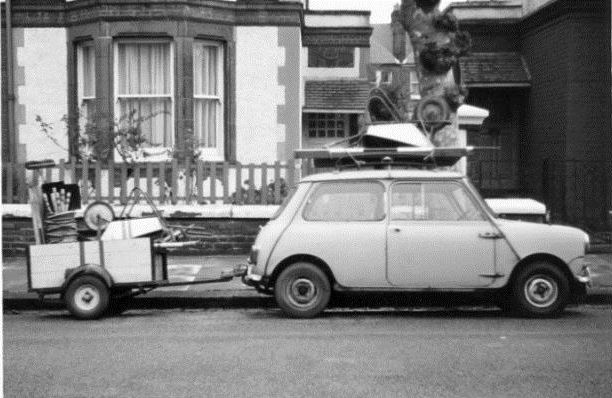
The Mini Minor and its trailer painted in the WHS colours of yellow with red stripes ready to set off loaded with WHS equipment, probably 1967-1969.
Photo © Nick Farrant/Fuentes.
City digs with Nick Farrant/Fuentes and WHS
St Nicholas Acon, Lombard Steet, 14-15 December 1963
WHS took over the site for one weekend, the first time the Society as a whole, rather than just individual members, volunteered to help out on Guildhall Museum excavations.
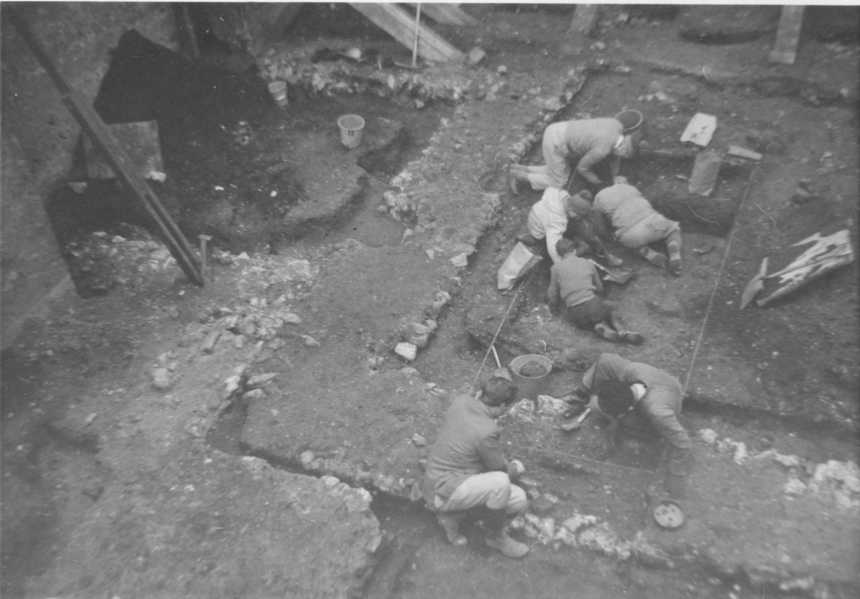
WHS at St Nicholas Acon 14-15 December 1963. Photo © Pete Atkins or Nick Fuentes.
Huggin Hill Roman Baths 1964 and 1969
This major Roman baths’ site threatened by redevelopment was excavated by Peter Marsden and the Guildhall Museum at the lower end of Huggin Hill, just north of Upper Thames Street. There was a strong presence of WHS diggers, especially in 1969. Nick Farrant/Fuentes was one of the regular weekend supervisors.
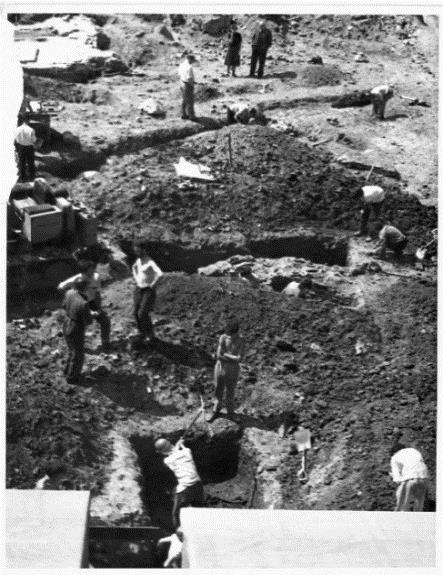
Huggin Hill Roman baths in 1964, lower far left Nick Farrant/Fuentes and Don Pollock of WHS.
Photo © Peter Atkins

Huggin Hill 1964 with WHS members. Photo © possibly by Stan Warren WHS
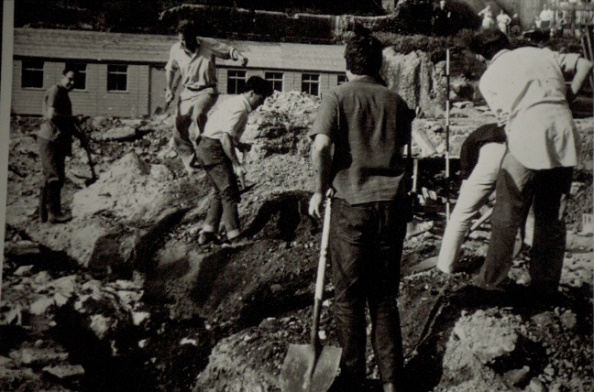
Huggin Hill 1964 with Nick Farrant/Fuentes digging in centre of photograph.Photo © Peter Atkins WHS.

Huggin Hill Roman baths 1969 with WHS equipment, Nick Farrant/Fuentes on the left.
Photo © Pamela Greenwood WHS.
Bush Lane 1964 – 1965
A Guildhall Museum excavation directed by Nick Farrant/Fuentes at weekends with WHS and other volunteers.
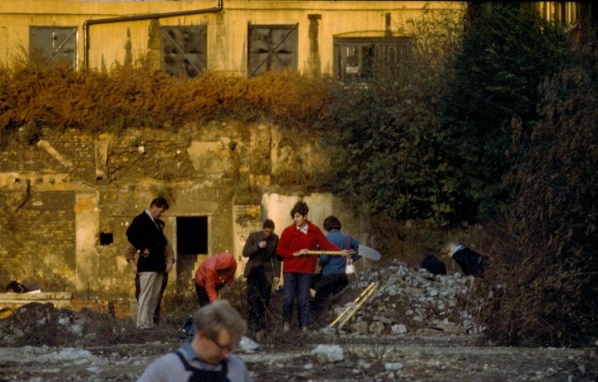
Bush Lane 1964.
Photo © Peter Atkins.

WHS at Bush Lane 1964.
Photo © Peter Atkins.
Lower Thames Street/Billingsgate Roman bath house 1969
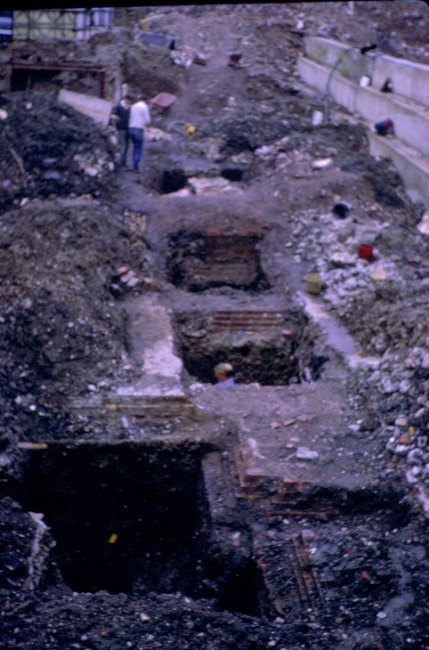
Lower Thames Street, building next to Billingsgate Bath House, 1969.
Photo © Nick Farrant/Fuentes WHS.
Baynard’s Castle 1972
With just a few days before the destruction of this important site, a massive volunteer presence of more than 70 people was organized and led by Nick Farrant/Fuentes to continue to excavate the site over the Easter 1972 weekend on behalf of Peter Marsden of the Guildhall Museum.
The public outrage and publicity in the press about the loss of this site led to the formation at the end of 1973 of the Department of Urban Archaeology with a small full-time excavation team, based at first at the Guildhall Museum. WHS members continued to volunteer on later phases next to the main site in 1973. This was the beginning of changes providing greater protection for archaeology.
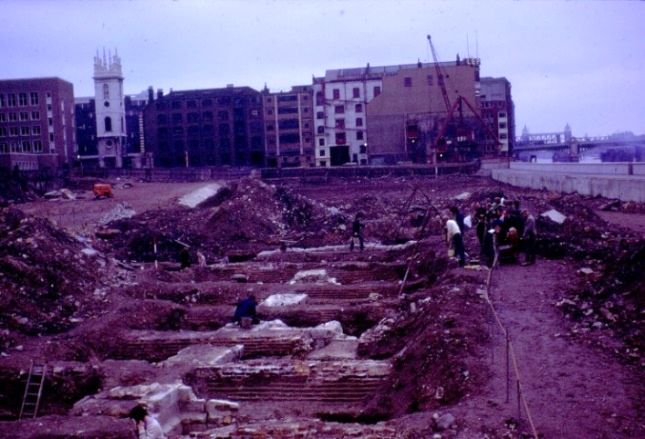
Baynard’s Castle Easter 1972. Photos © Nick Farrant/Fuentes.
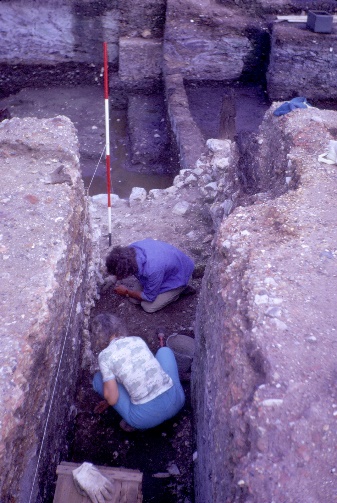
Baynard’s Castle Easter 1972 with Pat Loobey and Joan Loobey (nee Coleman). Photo © Nick Farrant/Fuentes.

Baynard’s Castle Easter 1972 with the Mini Minor and WHS trailer. Photos © Nick Farrant/Fuentes.

Baynard’s Castle Easter 1972: guided tours for the public in the background. Pamela Greenwood, a supervisor, walking along the top of the wall. Photo © Nick Farrant/Fuentes.
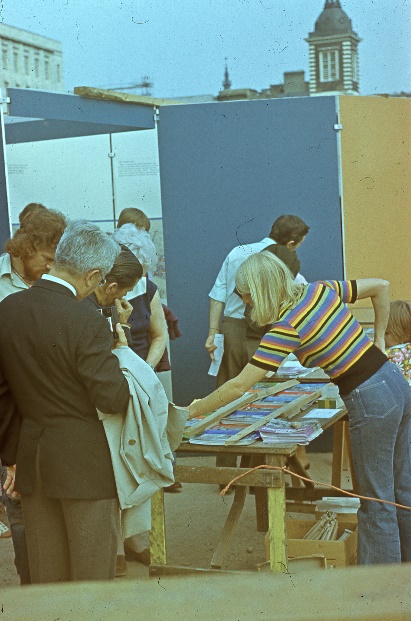
Baynard’s Castle Easter 1972, selling the London Archaeologist at the visitor viewing platform. Photo © Nick Farrant/Fuentes.
Mumford Court, Milk Street June – September 1972

Mumford Court 1972. Nick Farrant/Fuentes supervised the site for the Guildhall Museum and is here recording a structure.
Photo © James Slade WHS.
London Bridge (Southwark) 1967
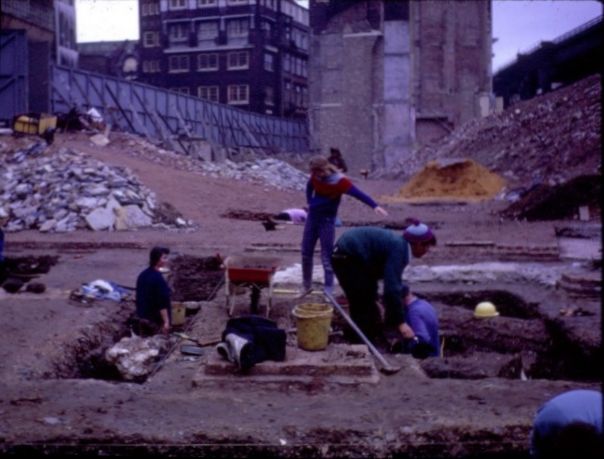
WHS at London Bridge excavations 1967 – Acting-Supervisor for a day, Pamela Greenwood on the left, with some other teenage WHS members and the distinctive WHS trailer and equipment.
Photo © Nick Farrant/Fuentes.
Local Sites
WHS continued digging regularly until the late 1980s especially in and around Felsham Road, Putney with a couple of small investigations in 1992 elsewhere. By then construction sites had become more problematic for volunteers working only at weekends, with more restrictions, greater speed and now often some funding for full-time archaeologists. Our most recent site was a watching brief in 2013 at the demolition of the remaining parts of Chatfield House in Putney High Street.
Some WHS Sites
Bemish Road, Putney 1965 and 1966
A part of Roman Putney was revealed with evidence of blacksmithing and many domestic and personal items. There were features such as ditches and pits, and the remains of burnt daub from some sort of a structure. This site was the confirmation of the Roman settlement in Putney.

BEM II 1965 with Nick Farrant/Fuentes, Peter Atkins and others. Note the Mortimer Wheeler-style trenches, here within a 10ft grid system. All the trenches were hand-dug.
Photo © Photographer not yet identified
6-12 The Platt, 5 Nov 1966- 2 April 1967 and 19 November – 10 December 1967
The first phase was hand-dug in the cramped back gardens behind the houses, but the second phase after demolition allowed the use of an earthmoving machine of the JCB type to clear the rubble before further excavation by hand.
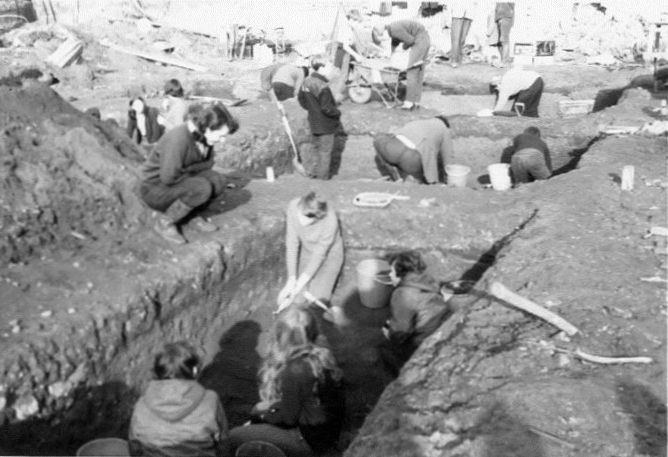
The Platt November – December 1967. The trench grid-system continues.Photo © Nick Farrant/Fuentes

The Platt December 1967 – excavation continued under cover of sheets of corrugated iron during the severe weather. Stan Warren standing on the snow-covered spoil heap. Photo © Nick Farrant/Fuentes.
Sefton Street, Putney 1969 and 1970
Here, as well as an abundant scatter of Mesolithic flints and Neolithic flints and pottery, there were traces of 10th-11th-century activity – narrow gullies and finds of shell-tempered pottery. Here the trenches were of varying size.
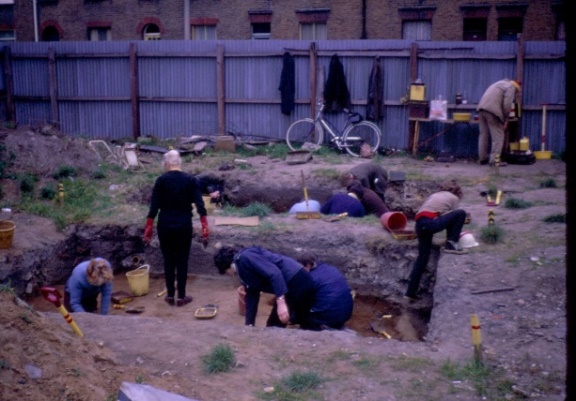
Sefton Street 1969, with Stan Warren in the background, by the tea-making area. Photo © Nick Farrant/Fuentes.
10 Bemish Road, 2 July – 24 August 1972
Next to the find spot of the Roman burial urns in 1962, this former depot site produced evidence of prehistoric Putney along with abundant Roman finds and features, such as ditches and pits.
With just a few weeks allowed for excavation, the concrete and modern layers were removed by machine as three large trenches extending across the site, leaving the plough soil and earlier layers to be dug by hand.
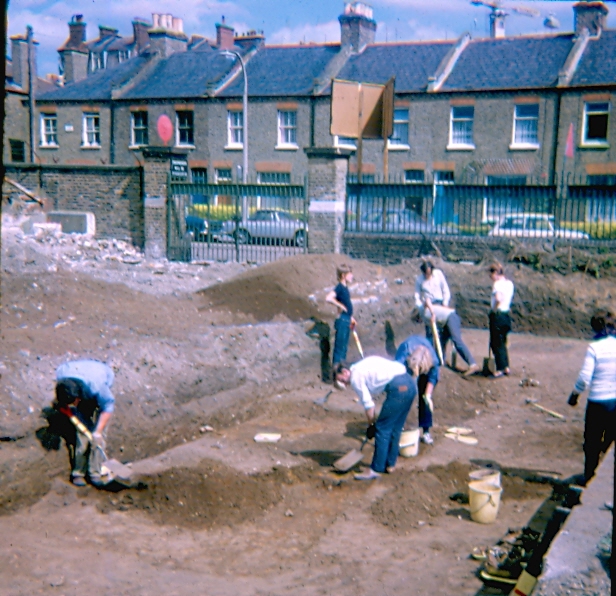
BEM III Area B with several Roman ditches. Photo © Pamela Greenwood.
St Mary’s Church, Putney 1973 – 1976
Following an extensive fire in 1973 WHS helped clear debris and protect the monuments and then carried out excavations in advance of restoration of the church.
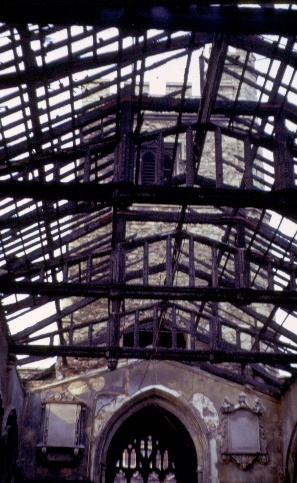
St Mary’s Church 1973 following the fire. Photo © Pamela Greenwood.

St Mary’s Church Putney – column base excavated by WHS.Photo © Pamela Greenwood.
38 Felsham Road, Putney 1976 – 1980
A large area, formerly a brewery depot and the horse bus garage, was excavated for several years from spring 1976 – revealing much Roman evidence including a road, prehistoric finds and features, with evidence too for Tudor and later use of the site in the 19th and 20th centuries. Here large areas were cleared both by machine and hand.

Nick Farrant/Fuentes at Felsham Road in 1976, director of the largest and longest WHS dig.
Photo © Pamela Greenwood.
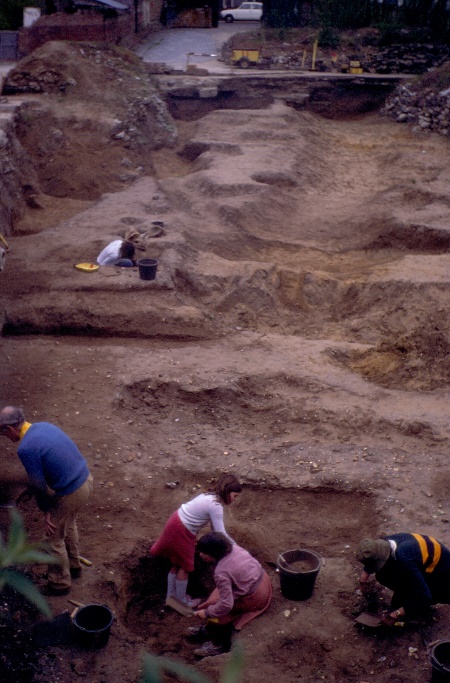
38 Felsham Road, Spring 1979, the Roman road ditch running N – S.Photo © Nicholas Farrant/Fuentes.
Chatfield House, Putney High Street – salvage watching brief 2013
Remains of Chatfield House, dating to around 1700, were revealed during demolition at Putney Exchange in advance of building the Hennes & Mauritz shop. Part of the oak timber roof also survived on the north end. A section of it was salvaged. WHS were given access for a watching brief to record the above-ground structures.
WHS had previously carried out excavations in the back garden area in 1966.

WHS Chatfield House, Putney 2013, Michael Bull examining the early brickwork. Photo © Pamela Greenwood.
Just over the border at Barn Elms in 1974
Rescue and salvage excavations in 1974 revealed two sites in the Barn Elms Playing Fields: at the North Thames Gas Pipeline shaft (BEV I B) and further upstream in the GLC River Defence Wall trench (BEV I A). Both areas produced important Iron Age finds and features. More information is available here
The Foreshore 1964 – present
In August 1964 the Group carried out its first foreshore survey or ‘mud lark’, making a number of important discoveries including the Putney fish trap in 1971 and many prehistoric and Roman finds. Our surveys are now in their 60th year!
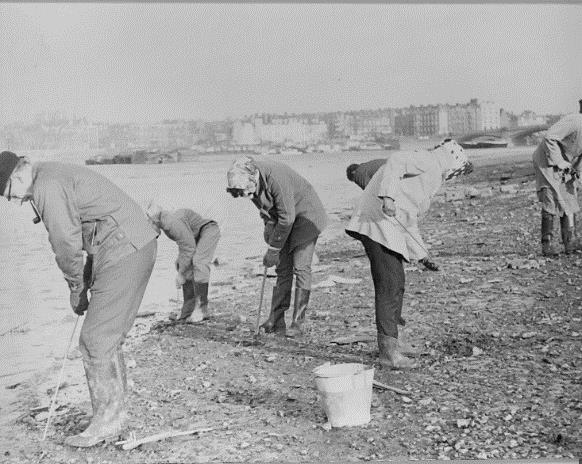
WHS Battersea Foreshore, probably early 1960s, with Don Pollock on the left. Photo © Photographer not yet identified.

Putney Foreshore 1971- WHS surveying the fish trap or weir, Jim Slade on the far left.
Photo © Nick Farrant/Fuentes.
WHS Campaign for a Borough Museum from 1962 onwards
Early exhibitions and displays showed off archaeological discoveries and local finds by WHS, culminating with the Wandsworth Through the Ages Exhibition in 1983 held for three weeks and visited by more than a thousand people. This provided inspiration and a catalyst for the creation of Wandsworth Museum in 1986 following decades of campaigning by WHS from 1962 onwards.
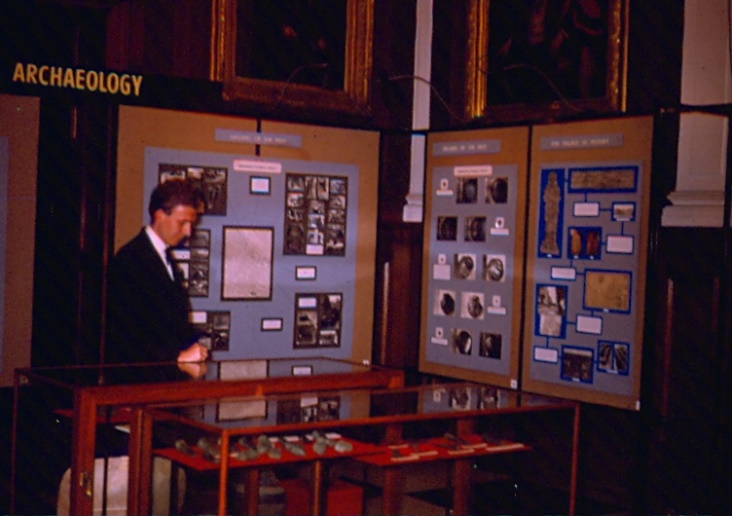
Archaeology part of the ‘Story of Wandsworth Exhibition’ 1964 to mark the creation of the current Borough, produced with major input from WHS. Photo © Peter Atkins or Nick Farrant/Fuentes?
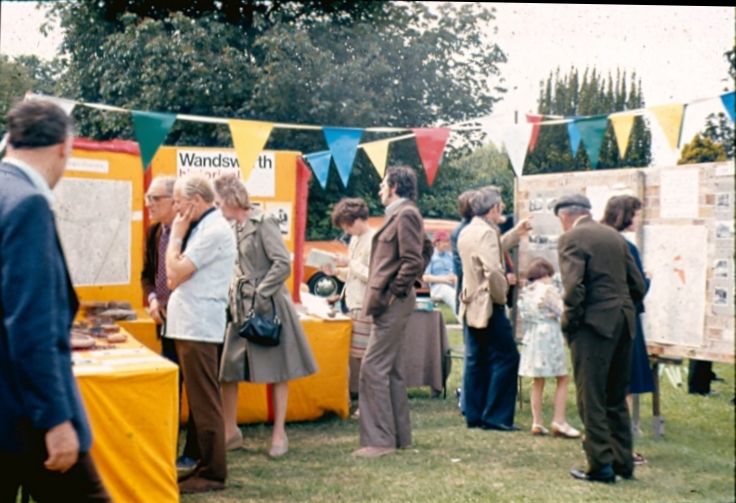
WHS displays at Putney Weekend 1973. Photo © Nick Farrant/Fuentes.

WHS Putney excavations on display at the Nationwide Building Society, Putney High Street in 1973.
Photo © Nick Farrant/Fuentes.
London Archaeologist
The London Archaeologist magazine was founded by Nicholas Farrant/Fuentes of our Society in 1968, a magazine that still lies at the heart of London’s archaeology today, London Archaeologist. For many years WHS members were involved with its production, distribution and organization.
With thanks to WHS members and other volunteers past and present who worked on these sites, often in difficult conditions, or helped in other ways, to various landowners and developers, and to Peter Marsden formerly of the Guildhall Museum (Museum of London) for information.
Pamela Greenwood July 2024.